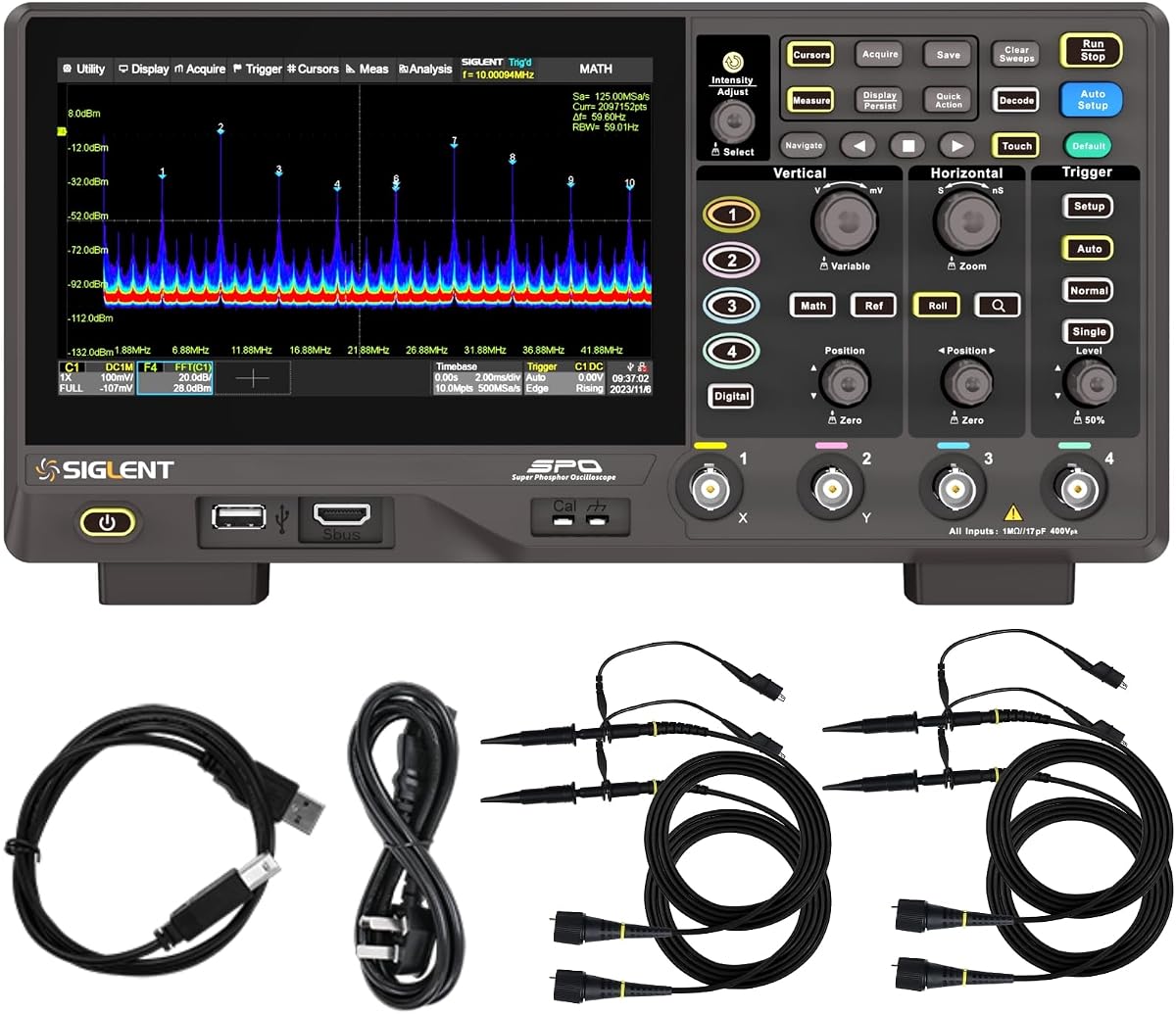
Siglent SDS814X HD
4.8Editor score
12-bit high resolution
4 channels at 100 MHz
7 inch touch screen
PC oscilloscopes are essential tools for engineers and hobbyists who need to visualize electrical signals accurately. These devices connect directly to your computer, allowing for advanced analysis and data logging without the bulk of traditional benchtop units.
We evaluated ten leading models based on bandwidth, sampling rates, channel count, and software compatibility. Our analysis focuses on real-world performance, ease of integration with existing workflows, and the overall value provided by each device for various testing scenarios.
Each selection highlights unique strengths whether you need high-speed digital decoding or portable automotive diagnostics. While prices and availability fluctuate over time, these picks represent the most reliable options available for precise signal observation and troubleshooting today.
4.8Editor score

4.7Editor score

4.1Editor score
As an Amazon Associate we earn from qualifying purchases.
The following table provides a side-by-side comparison of the top ten PC oscilloscope models. It highlights key specifications such as bandwidth, channel count, sampling rates, and unique features to help you differentiate between the various options available in the market.


The Owon VDS1022I stands out as a highly affordable option for users needing basic signal visualization. It boasts a bandwidth of up to 100MHz and a real-time sample rate of 1GS/s, which is impressive for its price point. The device features a friendly user interface that allows for FFT and X-Y views on the same screen.
We may earn a commission when you buy through this link, at no additional cost to you.
One of its strongest features is the integrated USB isolation, which protects your PC from signal interference and potential electrical damage. This safety feature is often missing in cheaper alternatives. The device supports multiple trigger modes including edge, video, slope, pulse, and alternate, making it versatile for various signal types.
While the hardware is robust, the software interface can sometimes lag when processing complex waveforms. Additionally, the build materials feel somewhat basic compared to premium benchtop models. However, for educational purposes or light industrial use, these trade-offs are acceptable given the low cost.
If you need a reliable entry-level PC oscilloscope that protects your computer and offers good sampling rates, this model is an excellent choice. It is perfect for students and hobbyists who do not require advanced decoding features but need accurate signal capture.
The included USB isolation ensures that high-voltage signals do not travel back to your computer, providing essential safety during live circuit testing.
Its ultra-thin body design makes it easy to carry in a bag, allowing you to take your diagnostic tool to different work sites or classrooms without hassle.
We may earn a commission when you buy through this link, at no additional cost to you.
The Siglent SDS1202X-E is a powerful digital oscilloscope that delivers professional-grade performance at a competitive price. With a 200MHz bandwidth and real-time sampling rate up to 1 GSa/s, it captures fast signals with high precision. The device offers a massive record length of up to 14 Mpts, allowing for detailed analysis of long signal sequences.
We may earn a commission when you buy through this link, at no additional cost to you.
This model excels in serial bus triggering and decoding, supporting protocols like IIC, SPI, UART, RS232, CAN, and LIN. This capability makes it ideal for embedded system debugging without needing extra hardware. The user interface is designed to be responsive and easy to navigate, even for complex tasks.
While it is a robust device, it relies on a PC connection for some of its advanced display and storage features. Also, having only two channels may limit users who need to monitor more signals simultaneously. However, the depth of analysis provided outweighs these limitations for most general engineering applications.
For professionals needing reliable serial decoding and high sampling speeds without breaking the budget, this oscilloscope is a top recommendation. It balances performance and usability effectively, making it a favorite among electronics engineers and repair technicians.
Integrated support for common serial protocols like IIC and CAN allows you to decode data streams directly on the screen, speeding up debugging workflows significantly.
The 1 GSa/s real-time sampling rate ensures that fast signal transitions are captured accurately, preventing aliasing and preserving signal integrity.
We may earn a commission when you buy through this link, at no additional cost to you.
The Siglent SDS814X HD represents a top-tier option for those needing high-resolution mixed signal analysis. It features a 12-bit analog-to-digital converter, which provides significantly better resolution than standard 8-bit scopes. This allows for the detection of smaller voltage details and noise on waveforms that other scopes might miss.
We may earn a commission when you buy through this link, at no additional cost to you.
It comes equipped with four analog channels and up to 2GSa/s sampling speed, ensuring detailed capture of complex signals. The device includes a 7-inch touchscreen that simplifies navigation and interaction with waveform parameters. Waveform capture rates reach up to 80,000 wfm/s in normal mode and 500,000 wfm/s in sequence mode.
A minor drawback is that the logic analyzer probes are sold separately, adding to the total cost if you need digital channel support. The price is also higher than other models on this list. Despite this, the superior resolution and touch interface make it a worthwhile investment for serious researchers and design engineers.
If you require the highest resolution and channel count for detailed circuit analysis, this is the premier choice in our lineup. Its advanced features and user-friendly touchscreen make it a powerful tool for any advanced laboratory or development environment.
The 12-bit ADC captures finer details in your signals, allowing you to see subtle variations that standard 8-bit scopes cannot resolve accurately.
The 7-inch touchscreen provides a modern, intuitive way to control settings and view waveforms, reducing the learning curve for new users.
We may earn a commission when you buy through this link, at no additional cost to you.
The Loto OSC482 is a unique virtual oscilloscope that combines five different tools into one USB device. It functions as an oscilloscope, signal generator, logic analyzer, and data logger all at once. With a sampling rate of 50M S/s and optional modules, it offers flexible configuration for different testing needs.
We may earn a commission when you buy through this link, at no additional cost to you.
Vertical resolution can reach up to 13 bits in HiRes mode, providing detailed signal views. You can combine it with additional modules to form an OSC482S or OSC482X depending on your specific requirements. The 5 in 1 nature makes it a comprehensive solution for hobbyists who want multiple tools without buying separate units.
The primary limitation is the 20MHz bandwidth, which is insufficient for high-frequency RF or fast digital video signals. Additionally, as a virtual device, it relies entirely on your computer to function. However, for low to medium frequency testing and logic analysis, it is extremely cost-effective and versatile.
Ideal for electronics enthusiasts needing a signal generator alongside a scope, this device offers great value. Its modular approach allows you to expand capabilities as your skills grow, making it a smart long-term investment for learning and repair work.
You can combine the main unit with signal generator or logic analyzer modules to create a custom setup that fits your specific project requirements.
In HiRes mode, the device achieves up to 13-bit vertical resolution, allowing for precise voltage measurements in low-frequency applications.
We may earn a commission when you buy through this link, at no additional cost to you.
The Autel MaxiScope MP608 is designed specifically for automotive diagnostics, turning tablets into professional testing tools. It features four channels with a bandwidth of 20MHz and a sample rate of 80MS/s to capture sensor and ignition signals accurately. The device offers a 12-bit vertical resolution with high DC accuracy for detailed fault detection.
We may earn a commission when you buy through this link, at no additional cost to you.
Advanced trigger modes including edge, pulse-width, window, and distortion help catch intermittent faults that are hard to reproduce. Custom math channels simplify signal comparison without manual calculation. Auto probe configuration automatically detects and calibrates OEM probes to prevent setup errors and invalid measurements.
Its main limitation is that it is optimized for automotive work, making it less useful for general electronics projects. The cost is also higher than standard generic scopes. However, for automotive technicians, it saves significant time by providing guided tests and factory reference waveforms.
If you work in vehicle repair and need to diagnose complex electrical networks, this scope is essential. Its guided library and decoding support make it easy to identify faults quickly, reducing the time spent on trial and error repairs.
The unit automatically detects connected probes like ignition pickups or attenuators and calibrates them instantly, saving setup time and preventing human error.
Preloaded test presets and step-by-step wiring guides help you diagnose sensors and actuators quickly without needing to consult heavy service manuals.
We may earn a commission when you buy through this link, at no additional cost to you.
This version of the Autel MaxiScope MP608 is an upgrade over the MP408, designed for professional automotive repair shops. It maintains 12-bit resolution and 20MHz bandwidth but adds enhanced capabilities for modern EV and hybrid network diagnostics. The device supports a wide range of compatible tablets for seamless integration.
We may earn a commission when you buy through this link, at no additional cost to you.
Advanced trigger functions lock onto fleeting glitches automatically, reducing testing steps and shortening troubleshooting time. It decodes multiple protocols like CAN, CAN FD, FlexRay, LIN, and I2C natively. This ensures you can view bus IDs and data without needing extra software or licenses.
While powerful, it is primarily useful for automotive technicians rather than general electronics hobbyists. The price point reflects its specialized nature. However, for shops dealing with complex network faults, this tool provides the necessary precision and guided support to ensure accurate repairs.
For professionals looking to upgrade their diagnostic capabilities, this is a robust and reliable choice. It combines high-precision waveform capture with guided procedures that streamline complex vehicle repair tasks and improve efficiency.
Native support for CAN FD, FlexRay, and other automotive protocols allows you to decode complex vehicle networks quickly and efficiently.
Each package includes complete test leads, probes, and accessories, so you can start diagnostics immediately after unboxing.
We may earn a commission when you buy through this link, at no additional cost to you.
The Siglent SDS1104X-E provides a solid 4-channel option for users requiring more inputs than standard scopes. It offers 100MHz bandwidth and a standard decoder for common protocols like IIC, SPI, UART, CAN, and LIN. This makes it suitable for complex circuit analysis where multiple signals must be monitored simultaneously.
We may earn a commission when you buy through this link, at no additional cost to you.
The unit supports an optional USB AWG module for waveform generation, adding versatility. It can be expanded with 16 digital channels to function as a Mixed Signal Oscilloscope (MSO). The build quality is sturdy, designed for frequent use in a lab environment.
However, the package weight is relatively heavy at 4.0 kg, which affects portability. It also focuses on standard decoding rather than advanced deep analysis features. For general purpose use with four channels, these limitations are minor compared to its stability and clarity.
If you need four channels for multi-signal analysis without breaking the bank, this model is a strong candidate. It delivers consistent performance and essential features that make it a workhorse for general electronics engineering tasks.
Built-in decoding for IIC, SPI, UART, and CAN protocols simplifies the process of viewing digital data alongside analog signals.
You can opt to add 16 digital channels to make this a Mixed Signal Oscilloscope, expanding its utility for digital logic analysis.
We may earn a commission when you buy through this link, at no additional cost to you.
The DSO 138 is a digital DIY oscilloscope kit designed specifically for students and educators learning about electronics. It features an ARM Cortex-M3 processor and a 2.4-inch color TFT display. This kit allows users to observe waveforms in audio and low-frequency applications easily.
We may earn a commission when you buy through this link, at no additional cost to you.
Because it is open source, you can tailor-make software development on this board to expand its utility. It serves as a development board itself, allowing for component soldering and chip component training. The small size makes it portable for field testing of basic signals.
Performance is limited to 1MSPS and basic frequencies, so it cannot handle high-speed digital or RF work. Assembling the kit requires care and some skill. However, for the price, it is unmatched as a teaching tool to understand internal oscilloscope principles and structure.
If you are looking for an affordable way to learn how oscilloscopes work or need a simple tool for basic debugging, this kit is perfect. It provides hands-on experience that is invaluable for students entering the electronics field.
The open source nature allows you to modify the software to change functions like creating a millivoltmeter or data recorder.
Designed specifically for teaching, this kit helps students understand oscilloscope structure and principles through hands-on assembly and in-line component training.
We may earn a commission when you buy through this link, at no additional cost to you.
The OS-5C is a highly portable oscilloscope with 5 channels for simultaneous monitoring. It connects via USB and WiFi, allowing flexible control. The 4.3-inch color screen provides a large viewing area with effective details. It weighs only 350g, making it easy to carry around for field work.
We may earn a commission when you buy through this link, at no additional cost to you.
It supports a sampling rate of 3Msps and focuses on low-frequency signals like audio and industrial control. It has a built-in 2000mAh battery that lasts up to 3 hours. You can record up to 90 hours of waveform data at a time using computer software.
The main limitation is the low sampling rate, which restricts use to low-frequency applications. High-speed signals cannot be captured effectively. However, for portable testing where weight and channel count matter more than speed, it is a convenient and practical tool.
For field technicians needing to monitor multiple low-frequency signals without a benchtop unit, this is a great choice. Its battery life and portability make it ideal for jobs where access to power is limited or mobility is key.
Weighing only 350g with a built-in battery, you can easily carry this device to remote locations for continuous work up to 3 hours.
Support for 5-channel synchronous monitoring reduces equipment switching time and helps you troubleshoot faults quickly with all signals visible.
We may earn a commission when you buy through this link, at no additional cost to you.
The Korg Nu:Tekt NTS-2 is a unique oscilloscope kit designed for musicians and creatives rather than engineers. It allows you to build your own device without soldering. It features a 4-channel oscilloscope to monitor control voltage and audio signals, along with a spectrum analyzer for frequency analysis.
We may earn a commission when you buy through this link, at no additional cost to you.
You can create custom waveforms using the included flexible generator. The interface is clean and intuitive, making it accessible for everyone. It offers dual stereo IN and THRU/OUT for versatile connectivity with audio gear. The device is compact and fits in the palm of your hand.
While it lacks the technical depth of professional scopes, it enhances learning and experimentation for audio producers. It is not intended for serious circuit debugging. However, for studio and live performance uses, it adds a visual precision to your setup that is often missing in music production.
If you are a musician wanting to visualize your sound and experiment with waveforms, this kit is ideal. Its simple design and creative features make it a fun and useful tool for audio enthusiasts and creators of all experience levels.
Assembly is easy with no soldering required, making it accessible for anyone to build and start experimenting immediately.
The included flexible waveform generator lets you create custom signals to test audio gear and effects pedals creatively.
We may earn a commission when you buy through this link, at no additional cost to you.
Choosing the right PC oscilloscope requires balancing technical specifications with your specific application needs. This section breaks down the critical factors to consider before making a purchase.
Bandwidth determines the highest frequency signal your oscilloscope can measure accurately. You should select a scope with a bandwidth at least five times higher than the highest frequency in your signal to ensure fidelity.
Always choose a scope with sufficient bandwidth to avoid missing signal details or experiencing aliasing during testing.
The sampling rate indicates how many samples per second the device takes. A higher sampling rate allows for more precise capture of fast signal transitions and ensures the reconstructed waveform is smooth.
Ensure the sampling rate is at least 2.5 to 5 times your signal bandwidth for reliable measurements.
Consider how many signals you need to monitor simultaneously. While 2 channels are standard, complex systems may require 4 or more. Also check if you need analog or digital channels for mixed-signal analysis.
Select a model with enough channels to handle your most complex testing scenarios without needing to switch probes constantly.
Memory depth determines how many samples you can store at a given sampling rate. Higher memory allows you to capture long duration signals without reducing the sampling rate which is crucial for analyzing glitches.
Look for devices with deep memory buffers to ensure you can capture extended signal sequences without sacrificing detail.
Check the connection types supported by the device. USB is common for PC scopes, but newer models offer WiFi or Ethernet for wireless monitoring. Ensure compatibility with your computer operating system.
Prioritize connectivity options that fit your workflow whether you need a direct cable connection or wireless flexibility.
Triggering stabilizes waveforms so they can be analyzed clearly. Advanced triggers like pulse width or distortion trigger help isolate intermittent faults. Look for models that support the trigger types you need.
Robust triggering features are essential for catching hard-to-reproduce faults and stabilizing complex signals.
The user interface affects how easy the device is to use. Touchscreens and large displays improve usability. Some models allow screen sharing directly to a PC which can be beneficial for teaching or presentations.
Choose a device with an intuitive interface that allows quick adjustments during live testing sessions.
Many PC oscilloscopes rely on software for advanced features like decoding and analysis. Check if the software supports serial protocols you need like CAN or IIC. Regular updates can also add new capabilities over time.
Verify software compatibility and features to ensure the device meets your specific analysis requirements before buying.
Always connect the ground clip of your probe to a known ground point on the circuit before connecting the signal tip. This prevents short circuits and ensures safety for both you and the equipment. For PC oscilloscopes, ensure your computer is grounded properly as well.
Calibrate your probes regularly using the square wave output on the device. If the wave is distorted or rounded, adjust the compensation trimmer on the probe until the wave is a perfect square. This step ensures your measurements are accurate.
Store your device in a dry, dust-free environment when not in use. Avoid exposing the unit to extreme temperatures or humidity. If your oscilloscope has a screen, avoid placing heavy objects on it to prevent cracking or damage.
A PC oscilloscope is a device that connects to a computer to visualize electrical signals. It uses software on the computer to display waveforms, offering advanced analysis features and storage capabilities compared to standalone units.
Yes, these models rely on a computer connection for display and control. You need compatible software running on your Windows or Android system to view and analyze the captured data effectively.
For general electronics work, a bandwidth of 100MHz is a good starting point. It allows you to test most microcontrollers and digital logic. However, high-speed RF work requires significantly higher bandwidth.
Most PC oscilloscopes function as standalone devices only with minimal capabilities. For full waveform display and detailed analysis, a computer connection is required to run the control software.
Digital oscilloscopes are standard now due to features like deep memory and easy data storage. Analog scopes are rarely used in PC formats. Stick with digital for better flexibility and analysis tools.
Yes, if the scope has built-in USB isolation like the Owon model. Without isolation, you risk damaging your computer if high voltages are present. Always check for safety features before connecting to a PC.
Yes, automotive specific models like the Autel MaxiScope are designed for this. They support vehicle protocols like CAN and have probes suited for ignition and sensor signals. Generic scopes may lack these specific features.
We have reviewed ten excellent PC oscilloscope options ranging from budget-friendly hobbyist kits to professional automotive tools. The Siglent SDS814X HD offers premium performance while the Owon VDS1022I provides reliable affordability for general use.
Prioritize bandwidth and channel count based on your most demanding projects. Features like USB isolation and serial decoding add significant value depending on your specific workflow. Choosing the right balance ensures you get the best utility for your investment.
Remember that prices and availability can change over time. Always check the current listings on the provided links before making a purchase to ensure you get the best deal and up-to-date specifications.