
MINISFORUM MS-S1 MAX
4.5Editor score
Unified memory architecture
Cluster deployment ready
Compact desktop footprint
This guide compares the top 10 Dual GPU AI Setup options for local inference and training, covering workstations, servers, and compact clusters for developers.
Building a powerful local machine learning environment requires careful hardware selection. A dual GPU AI setup offers significant advantages for running large language models and complex generative tasks without relying on cloud services. These configurations provide the necessary compute power and memory bandwidth to handle demanding workloads efficiently.
Our team evaluated ten distinct systems ranging from compact mini workstations to enterprise-grade servers. We focused on VRAM capacity, memory bandwidth, thermal design, and software compatibility to determine the best options. Each product was analyzed based on its ability to handle quantized models and multi-turn inference tasks effectively.
Each pick below highlights specific strengths for different user needs and budgets. You will find detailed specifications and practical advice for deployment in various scenarios. Please note that pricing and availability fluctuate frequently so verify current details before purchasing.
4.5Editor score

5.0Editor score

5.0Editor score
The following table provides a side-by-side comparison of key specifications across all ten selected systems to help you identify the right fit for your specific AI workloads.


This unique graphics card merges two Arc Pro B60 GPUs into one package offering 48GB of VRAM. It scores highly for enabling local inference of 70B class models without multi-card complexity.
We may earn a commission when you buy through this link, at no additional cost to you.
The dual GPU design delivers 394 TOPS of total compute power. Native support for PyTorch and vLLM ensures compatibility with major open-source models like DeepSeek and Qwen series.
While it requires a motherboard supporting PCIe lane bifurcation for full bandwidth the design simplifies cabling and power management. This trade-off is acceptable for developers wanting high VRAM without server rack costs.
Ideal for researchers and engineers needing high-concurrency inference. This card is the top pick for those prioritizing memory capacity within a desktop form factor.
The 48GB VRAM allows running quantized models like DeepSeek-R1:70B entirely on one card eliminating cloud dependency.
Each chip is recognized separately by the system enabling flexible task assignment and efficient load balancing for complex workloads.
We may earn a commission when you buy through this link, at no additional cost to you.
This workstation pairs dual RTX PRO 6000 Blackwell GPUs with a powerful Ryzen 9 9950X processor. It is designed for professional environments needing reliable enterprise-grade performance.
We may earn a commission when you buy through this link, at no additional cost to you.
The 256GB DDR5 RAM supports heavy data processing alongside GPU tasks. A 360mm liquid cooler ensures the CPU stays stable during extended training sessions.
The price is substantial but justified by the pre-tested and managed build quality. Users save time on setup and avoid compatibility issues common with custom builds.
Best for businesses requiring turnkey AI stations. This setup is ideal where uptime and professional support are critical priorities.
RTX PRO 6000 Blackwell GPUs deliver superior reliability and memory bandwidth for professional AI workloads and data science pipelines.
Liquid cooling keeps the processor stable under load ensuring consistent performance for long-running inference or training jobs.
We may earn a commission when you buy through this link, at no additional cost to you.
This AI builds on consumer high-end graphics with two RTX 5090 GPUs and a powerful Ryzen 9 9950X processor. It is tailored for AI ML workloads needing massive GPU power.
We may earn a commission when you buy through this link, at no additional cost to you.
The 256GB DDR5 RAM prevents system bottlenecks when feeding data to GPUs. An 8TB NVMe SSD setup ensures fast dataset loading and storage.
Stress testing in Ohio ensures reliability. Users should note the power supply requirements for peak performance. The premium price reflects the high-end components used.
Recommended for developers wanting top-tier consumer GPU performance. This workstation delivers raw power for local training and complex inference tasks.
Dual RTX 5090s provide immense compute power while maintaining broader software compatibility compared to workstation cards.
RAID NVMe SSDs eliminate data bottlenecks allowing rapid ingestion and processing of large datasets essential for AI training.
We may earn a commission when you buy through this link, at no additional cost to you.
NVIDIA DGX Spark brings supercomputer performance to a desktop via the Grace Blackwell architecture. It is designed for rapid prototyping and secure local testing.
We may earn a commission when you buy through this link, at no additional cost to you.
The unified memory architecture allows access to 128GB per unit which supports large model fine-tuning. Full NVIDIA AI software stack integration simplifies deployment.
While it costs more than generic hardware the optimized software stack saves development time. It is ideal for organizations needing secure on-premise AI.
Best for teams prioritizing NVIDIA ecosystem compatibility and security. This solution offers exceptional ROI for increased productivity and faster innovation.
With 128GB unified memory per unit you can run models up to 200 billion parameters locally without relying on cloud resources.
Seamless integration of the full NVIDIA AI software stack ensures you can develop locally and deploy anywhere efficiently.
We may earn a commission when you buy through this link, at no additional cost to you.
This server is built for high performance computing clusters with dual AMD EPYC 9005 processors. It supports up to eight high-end GPUs for massive parallel processing.
We may earn a commission when you buy through this link, at no additional cost to you.
The 24-channel DDR5 memory and up to 10 NICs provide immense bandwidth. ASUS Control Center software simplifies management and security for large deployments.
The price and physical size mean it is not for personal use. However for research institutes it offers unmatched scalability and power for training.
Recommended for institutions needing cluster-ready infrastructure. This system delivers maximum throughput for distributed training and heavy AI inference.
Supporting eight high-end GPUs in a 4U chassis allows for unprecedented compute density in a compact data center footprint.
Support for up to 15 NICs including high-bandwidth options ensures low latency communication essential for multi-node clusters.
We may earn a commission when you buy through this link, at no additional cost to you.
The Iron Bull workstation uses a Ryzen Threadripper 9970X paired with an RTX 5090 GPU. It is designed for specialized workflows like PIX4Dsurvey and heavy CAD.
We may earn a commission when you buy through this link, at no additional cost to you.
The 128GB ECC RAM adds stability for critical data processing. Fast 10GbE networking ensures quick data transfers between systems.
While not strictly dual GPU focused it offers single GPU power with massive CPU capability. The build quality ensures longevity in demanding professional environments.
Best for engineers needing CPU and GPU power. This system balances performance and reliability for visualization and simulation tasks.
Designed specifically for tools like PIX4Dsurvey this system ensures optimized performance for mapping and surveying workflows.
ECC Reg DDR5 RAM prevents data corruption during long rendering or calculation tasks ensuring reliable results.
We may earn a commission when you buy through this link, at no additional cost to you.
This workstation uses a 192-core AMD EPYC processor and three RTX PRO 6000 GPUs. It targets engineering and deep learning workloads needing high memory bandwidth.
We may earn a commission when you buy through this link, at no additional cost to you.
The 768GB RAM pool and Gen5 NVMe storage remove data bottlenecks. Triple GPUs provide 288GB total VRAM for massive visualizations.
The price is high but reflects server-grade reliability and US-based support. A 3-year warranty provides confidence for critical deployments.
Ideal for engineering firms needing local training and rendering. This setup offers unmatched power for complex physics simulations.
With 768GB RAM and 288GB VRAM this system handles multi-million polygon assemblies and large datasets without swapping.
Designed for local LLM training it eliminates cloud latency allowing private and secure model development cycles.
We may earn a commission when you buy through this link, at no additional cost to you.
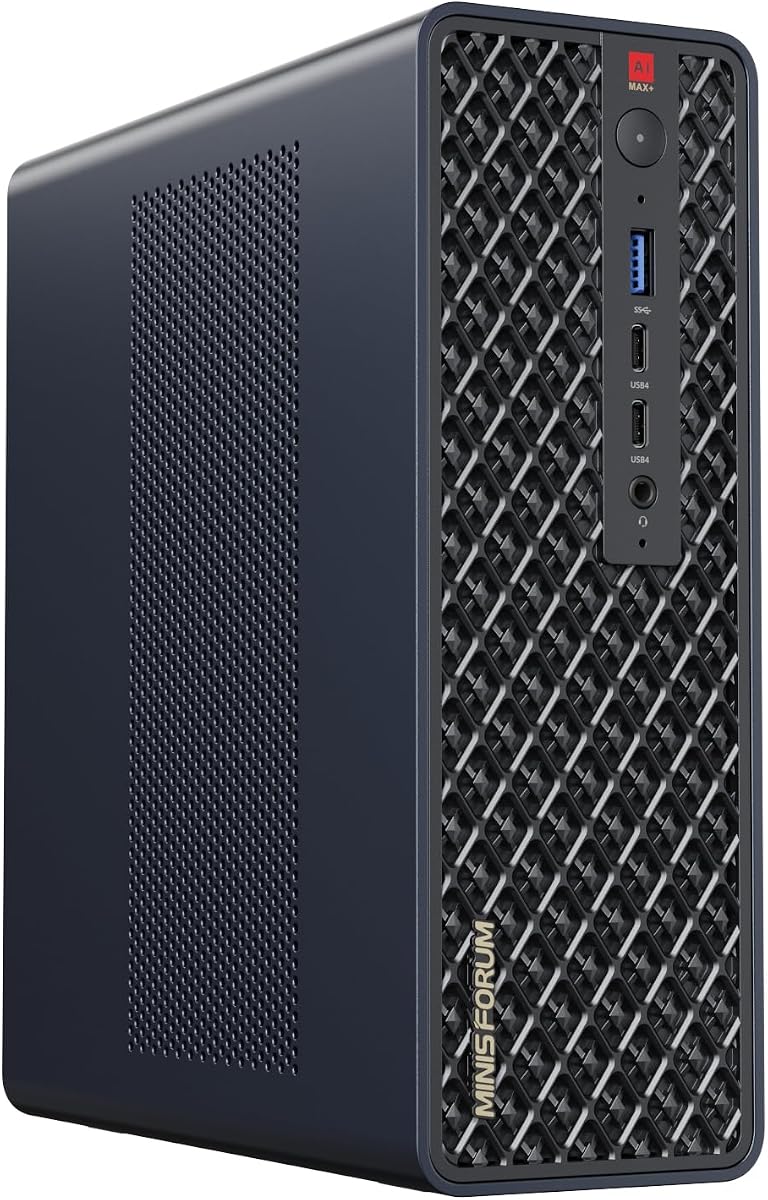
The MS-S1 MAX offers powerful AI performance in a tiny desktop case. It uses unified memory allowing CPU and GPU to share 128GB LPDDR5x.
We may earn a commission when you buy through this link, at no additional cost to you.
By connecting two units as a cluster you can run larger models like DeepSeek-R1 671B Q4 locally. This is a cost-effective way to scale without buying servers.
While not upgradable like towers the design allows easy upgrades of storage and maintenance. Cooling is efficient despite the small chassis.
Best for individuals needing compact local inference. This mini PC is the best budget option for entry-level AI development and testing.
Two units can be configured to run a 235B Q4 model locally achieving high throughput in a small footprint.
The 128GB shared pool eliminates VRAM bottlenecks ensuring smooth data transfer during high-intensity computations.
We may earn a commission when you buy through this link, at no additional cost to you.
This GPU packs 96GB of next-gen GDDR7 ECC memory into a compact dual-slot design. It is built for agentic workflows and advanced data science.
We may earn a commission when you buy through this link, at no additional cost to you.
At 300W it provides strong performance while fitting easily into standard desktops. The high bandwidth ensures zero-lag editing and real-time encoding.
Ideal for creators needing high VRAM without full server costs. The Max-Q design balances thermal management with powerful output for research labs.
Recommended for studios needing enterprise hardware. This card bridges the gap between calculation and visual output effectively.
Delivering up to 3511 TOPS while capping power at 300 watts makes multi-GPU desktop scaling viable.
Blisteringly fast 1792 GB/s bandwidth guarantees zero-lag multi-stream editing and real-time encoding.
We may earn a commission when you buy through this link, at no additional cost to you.
This mini PC uses the Ryzen AI Max+ 395 processor offering up to 126 TOPS performance. It supports five 8K video outputs simultaneously.
We may earn a commission when you buy through this link, at no additional cost to you.
Two 10GbE ports ensure fast wired connections while Wi-Fi 7 covers wireless needs. The included PCIe slot allows limited expansion.
It balances efficiency and performance with excellent heat dissipation. The quiet operation makes it suitable for office or studio environments.
Best for digital signage and light AI. This system delivers multi-monitor productivity in a compact reliable package.
Five video outputs support multiple monitors improving work efficiency for CAD or financial data visualization.
Dual 10GbE ports allow high-speed network connections essential for software routers or network isolation tasks.
We may earn a commission when you buy through this link, at no additional cost to you.
Selecting the right dual GPU setup involves balancing VRAM capacity memory bandwidth and physical constraints. Consider these factors before purchasing.
VRAM is critical for running large models. Aim for at least 48GB total if possible to avoid swapping and maintain speed.
Higher VRAM allows you to run larger quantized models locally which reduces reliance on cloud services.
Bandwidth dictates how fast data moves between memory and processors. Look for DDR5 or LPDDR5x RAM for high throughput.
Fast memory ensures your GPU does not stall waiting for data improving overall inference speed.
Dual GPUs generate significant heat. Ensure your system has robust cooling like liquid or large fans for sustained loads.
Effective thermal management prevents throttling which would reduce performance during long tasks.
The CPU prepares data for GPUs so a strong processor with many cores helps maintain GPU utilization.
A powerful CPU ensures your GPU stays fed with data and prevents system bottlenecks.
Dual GPU setups require high wattage PSUs. Ensure your unit provides enough clean power with adequate connectors.
A reliable PSU ensures system stability and longevity during continuous operation.
Check for PCIe slots or expansion ports if you plan to add components later.
Flexibility allows you to upgrade storage or network cards as your needs grow.
Confirm the system supports frameworks like PyTorch or vLLM for your specific models.
Native support simplifies deployment and reduces compatibility issues.
Measure your space to ensure a full tower fits or consider mini PCs for smaller areas.
A compact design helps integrate the setup into office desks efficiently.
Begin by installing all latest drivers for your GPU and CPU. Ensure operating system updates are applied for optimal stability.
Configure your AI software to detect and utilize both GPUs. Assign workloads evenly across the cards for better speed.
Monitor temperatures regularly using tools to prevent overheating. Keep dust out of fans and vents to maintain cooling efficiency.
Ideally use matching GPUs for balanced performance. Ensure your motherboard supports multiple PCIe lanes and bifurcation to avoid bottlenecks.
A 70B quantized model usually requires around 48GB VRAM. Systems with lower memory may rely on CPU offloading which is slower.
Dual GPUs allow parallel processing which speeds up training and handling multiple inference requests simultaneously.
Liquid cooling is beneficial for high-end CPUs to maintain stable performance during long workloads.
Yes your motherboard must support PCIe lane bifurcation to ensure full bandwidth for multiple GPUs.
Yes mini PCs like the MS-S1 MAX can be clustered to combine memory and compute power.
The WEELIAO MAXSUN and APC systems offer powerful dual GPU solutions for different budgets and space needs.
Prioritize VRAM and thermal design to ensure your setup handles large models efficiently.
Check current prices and availability before purchasing to ensure you get the best value.